
Company overview
Skyscanner is a global travel leader that helps millions of users find the best prices on flights, hotels, and car rentals. Its platform serves millions of users daily, supported by a world-class engineering organization of over 800 people. For Senior Engineering Manager Stuart Ross, a top priority was equipping this team with the tools and capabilities to master an increasingly complex technical landscape
Like many organizations at scale, Skyscanner faced a problem that code alone couldn't solve: the operational complexity of running hundreds of engineers, thousands of services, and dozens of initiatives simultaneously. To build a true Engineering Operations muscle, his team turned to Cortex and achieved significant results.
Key wins:
Landed three major engineering-wide initiatives, each faster than the last, proving that continuous improvement in how the org operates compounds over time.
Eliminated a fragmented toolchain by decommissioning multiple legacy systems, redirecting engineering time toward higher-impact work.
Replaced manual spreadsheets and Confluence tables with a single source of truth, giving leaders the visibility to drive initiatives with confidence instead of chasing status updates.
Reduced cycle time by 50% for a critical, traveler-facing system and used that data to spread the same operational learning across other teams.
The Challenge: Operational complexity at engineering scale
Before implementing Cortex, managing large, engineering-wide initiatives was a significant operational burden for Skyscanner. The platform team relied on a patchwork of manual tracking systems that were difficult to maintain and scale.
"There would usually be spreadsheets involved," Stuart explains. "If it wasn't spreadsheets, it would be large Confluence documents with big tables that were hard to update, particularly when there's lots of people trying to update them at the same time."
This manual approach was complicated by a fragmented toolchain. An early attempt at a homegrown IDP that was built and maintained by a small security team couldn't keep pace with the organization's needs. This led other teams to build their own supplemental tools to fill the gaps, which ultimately created a confusing landscape of numerous tools all trying to solve common challenges without a central source of truth.
The Solution: A Platform for Engineering Operations
Skyscanner's leadership recognized that the answer wasn't more disparate tools. They needed an operational foundation. One that could bring visibility, standards, and workflows together in a single place.
"We really needed a one-stop solution that could give us all of the features and capabilities that we needed through a single product. That was Cortex for us."
— Stuart Ross, Senior Engineering Manager, Skyscanner
By centralizing their engineering data in Cortex, Skyscanner gained the infrastructure to do what every high-performing engineering organization needs: provide clarity, drive improvement, and remove friction. Instead of maintaining a disjointed collection of homegrown systems, the team could focus on executing high-impact initiatives and raising the operational maturity of the organization.
The Result: An engineering org that gets better over time
Since adopting Cortex, Skyscanner's ability to execute has transformed.
"We've completed three large engineering-wide initiatives. Each one landed faster than the one before, setting a really high bar for us as a team."
— Stuart Ross, Senior Engineering Manager, Skyscanner
The operational gains also created space to simplify. "The other efficiency gain for us has been to really close down and shut down old systems that are no longer needed because we've now got that functionality out of the box with Cortex," says Stuart. Fewer tools. Less tribal knowledge. More time for engineering work that matters.
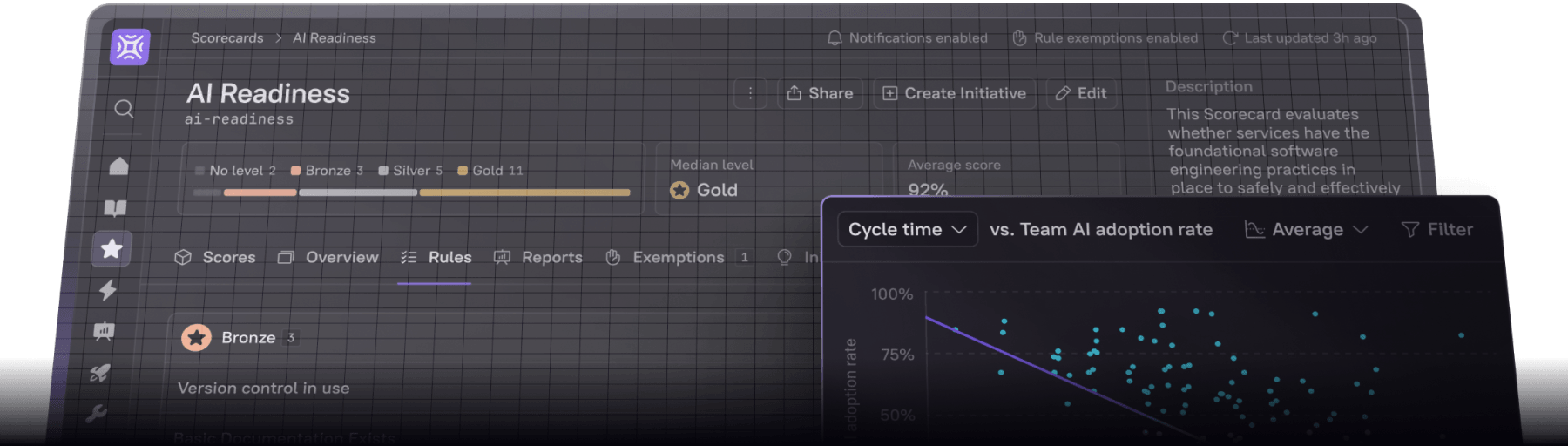
One team captured the impact by using Cortex's DORA dashboard. They reduced their cycle time by 50% for a critical, traveler-facing system from Q1 to Q2. But the real value went beyond the metric. "They now use that data as a mechanism for applying that learning to other systems," Stuart adds. "I think it's been really powerful for them." That's the EngOps flywheel: insights turning into action, action turning into improvement, improvement turning into a repeatable system.
A cultural shift toward engineering excellence
Perhaps the most meaningful result is what's happening to the culture. Operational maturity is no longer a compliance checkbox, it's become a shared language for how Skyscanner engineers think about getting better.
"It's driving a really important message to anyone who works in an engineering function," Stuart says. "Words like maturity and compliance, which historically can be labeled as negative, are now part of broader discussions around productivity and improving people's day-to-day lives. The community feel is definitely driving a real kind of change, and that's something I'm personally quite excited about."
This is Engineering Operations becomes a competitive advantage: organizations that don't just ship software, but continuously improve, are the ones that win.
Ready to build your Engineering Operations foundation? See how Cortex helps engineering organizations continuously improve operational maturity and reduce developer friction. Book a demo today.